Index / Work / N° 12
Project N°12 of 24
CategoryDesign · Simulation
Year2025

Thermal Management & Cold Plate Design

Engineered and simulated an aluminum water-cooled cold plate to manage thermal dissipation in a high-density Multi-Chip Module (MCM), ensuring the system maintained a maximum operating temperature below 40°C.

Key Engineering Contributions

  1. 01
    Thermal System Design: Designed the internal architecture of a water-cooled cold plate to effectively dissipate a uniform heat flux of 105 W/m2 generated by the simulated electronic components.
  2. 02
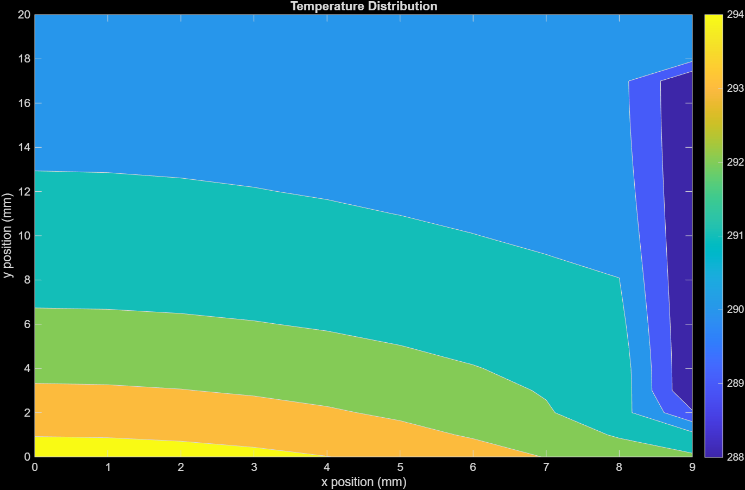
    Computational Heat Transfer (FEA): Conducted rigorous thermal simulations in MATLAB and SolidWorks to model the heat conduction through the aluminum substrate and the forced convection into a 15°C internal water flow.
  3. 03
    Analytical Fluid Modeling: Developed mathematical algorithms in MATLAB to compute the Reynolds Number, convective heat transfer coefficient (h) across varying internal channel geometries, and temperature distribution optimizing the design for maximum thermal efficiency.

Visual Documentation
Sample calculation of a node based on 2-D heat transfer principal equations (ene
Figure 1
01.png
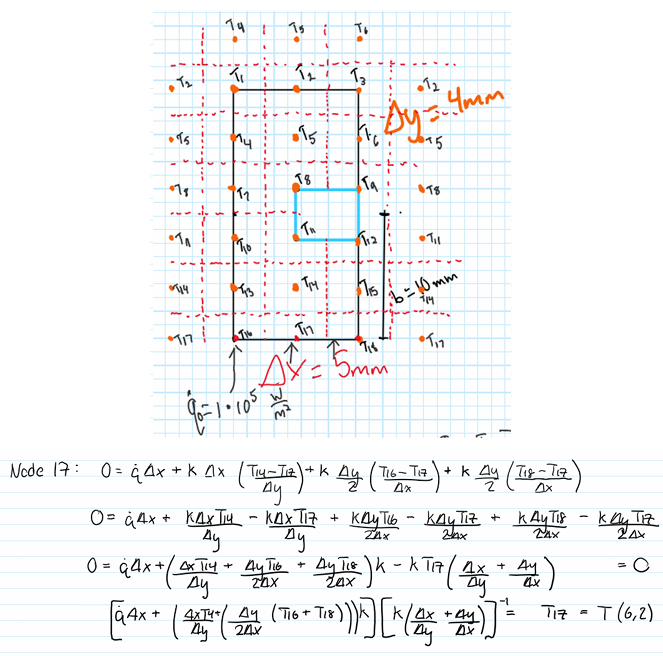
Sample calculation of a node based on 2-D heat transfer principal equations (energy balance). These conditions are of different spacing than the code used in the MATLAB program as the nodes are much c
Sample calculation of a node based on 2-D heat transfer principal equations (energy balance). These conditions are of different spacing than the code used in the MATLAB program as the nodes are much closer together for higher accuracy. Please note this is a symmetrical section of the MCM with constant heat flux from the bottom surface and an insulated top surface (assumed adiabatic)
Contour Plot made in MATLAB of the study of the water channel’s dimensions at a
Figure 2
02.png
Contour Plot made in MATLAB of the study of the water channel’s dimensions at a width of 2mm and a height of 2 mm with nodes spaced evenly, 𝛥𝑥 = 1𝑚𝑚 and 𝛥𝑦 = 1𝑚. The MATLAB program calculates the wate
Contour Plot made in MATLAB of the study of the water channel’s dimensions at a width of 2mm and a height of 2 mm with nodes spaced evenly, 𝛥𝑥 = 1𝑚𝑚 and 𝛥𝑦 = 1𝑚. The MATLAB program calculates the water channel’s Reynolds number, nusselts number, resultant heat transfer rate, and then uses the 2D heat transfer principal equations to calculate steady state temperature distribution across the nodes.
SolidWorks simulation contour plot of thermal analysis of square channel with a
Figure 3
03.png
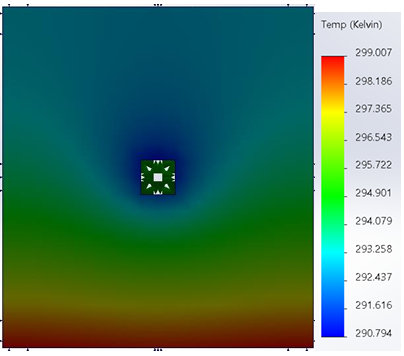
SolidWorks simulation contour plot of thermal analysis of square channel with a width and height of 2mm. SolidWorks utilizes calculated heat transfer coefficients from MATLAB to confirm the program’s
SolidWorks simulation contour plot of thermal analysis of square channel with a width and height of 2mm. SolidWorks utilizes calculated heat transfer coefficients from MATLAB to confirm the program’s calculated temperature distribution.
MATLAB dot plot of one of multiple parametric studies to optimize the design wit
Figure 4
04.png
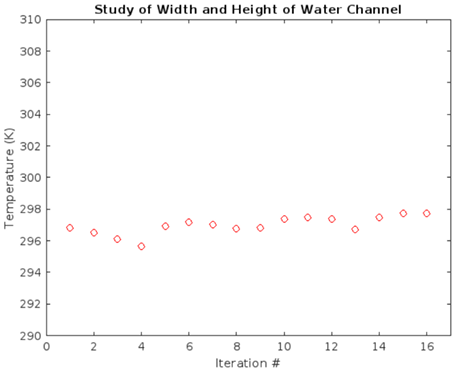
MATLAB dot plot of one of multiple parametric studies to optimize the design with respect to thermal performance. This specific study examines the maximum temperatures at 16 different width and height
MATLAB dot plot of one of multiple parametric studies to optimize the design with respect to thermal performance. This specific study examines the maximum temperatures at 16 different width and height combinations with all other variables held constant.
MATLAB and SolidWorks simulation countour plots of the final optimized design. T (image 1 of 2)
Figure 5.1
05-1.png
Part 1 of 2
MATLAB and SolidWorks simulation countour plots of the final optimized design. T (image 2 of 2)
Figure 5.2
05-2.png
Part 2 of 2
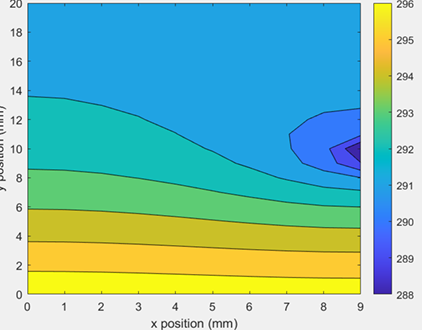
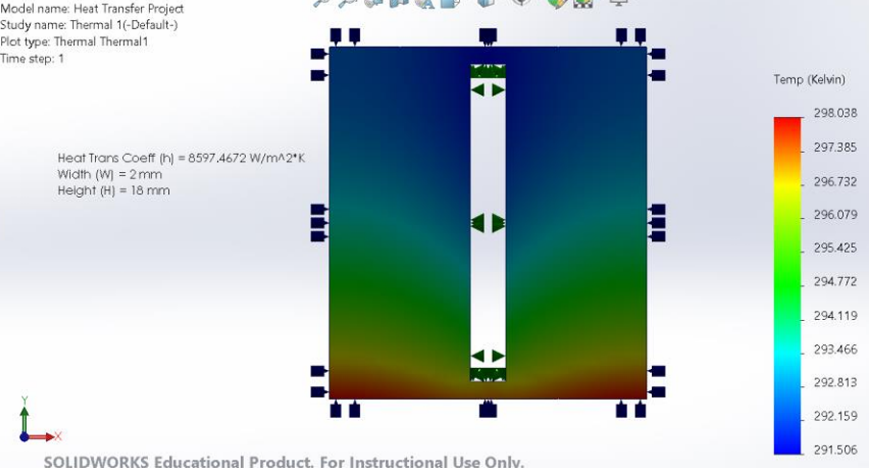
MATLAB and SolidWorks simulation countour plots of the final optimized design. The most effective configuration includes the following: 2 mm width x 16 mm height water channel, optimal water channel centerline heigh of 10 mm, optimal flow rate of 7 x 10⁻⁵ m3/s, optimal width of cold plate of 9. This resulted in the lowest maximum temperature of 298.038 K (SolidWorks simulation)