Simulated human gait dynamics within OpenSim to evaluate and optimize the assistive force of a powered ankle exoskeleton, aiming to minimize the wearer's metabolic cost of locomotion.
Key Engineering Contributions
01
Musculoskeletal Modeling: Conducted Inverse Dynamics (ID) analysis on a 10-DOF, 18-muscle human gait model to calculate lower-limb joint torques and establish baseline metabolic costs for key muscles (e.g., soleus, tibialis anterior).
02
Wearable Device Integration: Simulated the integration of both passive (spring-damper) and active (PlantarFlexAssist) assistive devices directly into the human gait model to observe their impact on joint kinematics and muscle exertion.
03
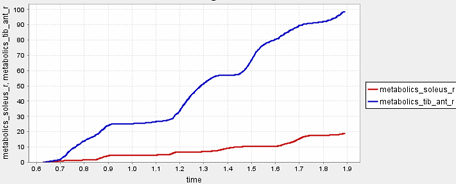
Metabolic Cost Reduction: Iteratively tuned the active actuator's optimal force scaling, successfully reducing the integrated metabolic cost of the soleus muscle to a highly efficient target of ~15 J over a single gait cycle.
Visual Documentation
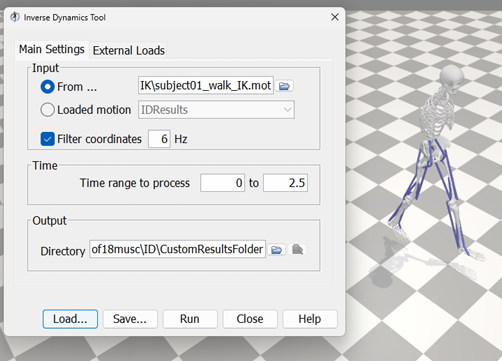
Figure 1
01.png
OpenSim Musculoskeletal Model: 10-DOF, 18-muscle lower limb model utilized for inverse dynamics and gait simulation
Figure 2
02.png
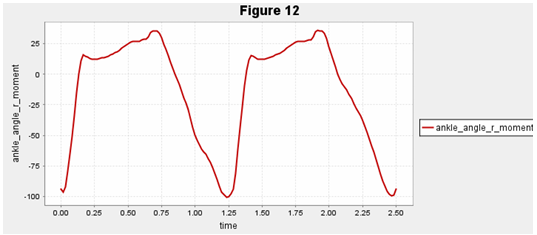
Plot of right ankle torque profile over time during unassisted walking
Figure 3
03.png
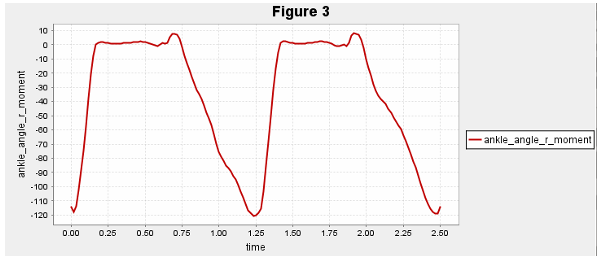
Plot of right ankle torque profile over time while walking with a passive spring. Parameters of the biarticular spring damper are a resting-length of 0.4 m, stiffness of 10000.0 N/m and dissipation of
Plot of right ankle torque profile over time while walking with a passive spring. Parameters of the biarticular spring damper are a resting-length of 0.4 m, stiffness of 10000.0 N/m and dissipation of 0.01 s/m. Lower maximum peaks may be observed relative to its unassisted counterpart.
Figure 4
04.png
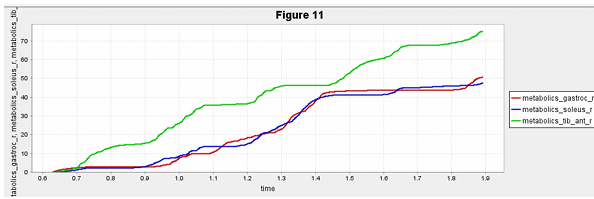
Plot of integrated metabolic cost of right gastrocnemius, soleus, and tibialis anterior muscles during unassisted walking
Figure 5
05.png
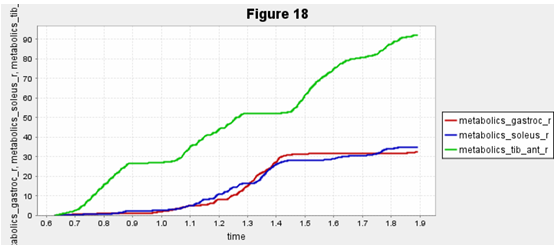
Plot of integrated metabolic cost of right gastrocnemius, soleus, and tibialis anterior muscles during spring-assisted walking. The tibialis anterior experiences more metabolic cost while the gastroc
Plot of integrated metabolic cost of right gastrocnemius, soleus, and tibialis anterior muscles during spring-assisted walking. The tibialis anterior experiences more metabolic cost while the gastrocnemius and soleus muscles experience less metabolic cost relative to their unassisted counterparts.
Figure 6
06.png
Plot of integrated metabolic cost of right gastrocnemius, soleus, and tibialis anterior muscles during active-assisted walking. The tibialis anterior muscle experiences much higher metabolic cost and
Plot of integrated metabolic cost of right gastrocnemius, soleus, and tibialis anterior muscles during active-assisted walking. The tibialis anterior muscle experiences much higher metabolic cost and the soleus muscle experiences lower metabolic cost.